Education is most effective when learners are given the chance to grow their understanding over time. One approach used in many modern curricula is called spiral progression. This method allows students to revisit key concepts repeatedly, each time at a deeper and more advanced level. Instead of learning a topic once and leaving it behind, students return to it in later grades with expanded skills and broader knowledge.
What Is Spiral Progression?
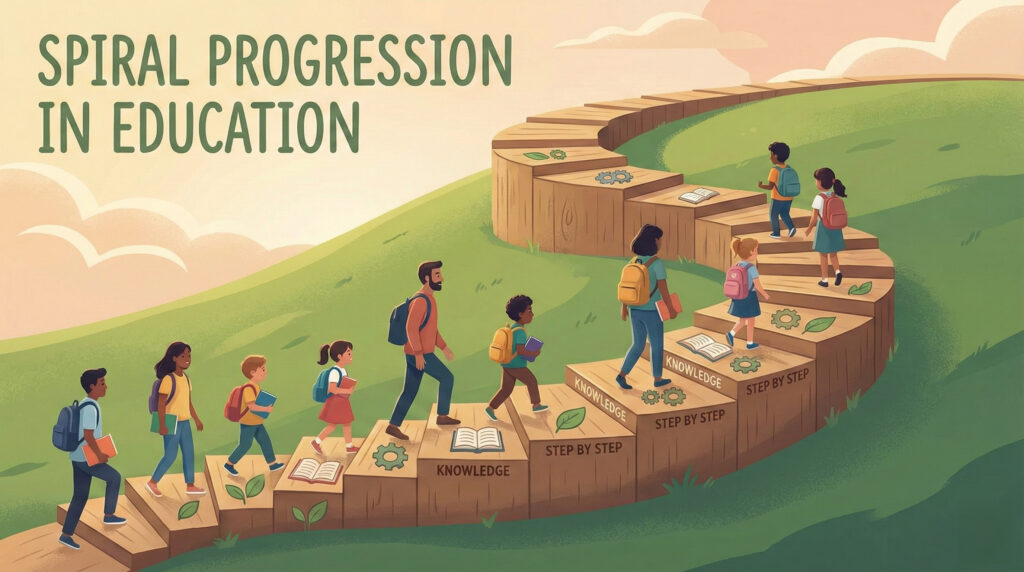
Spiral progression is a teaching and learning approach where important concepts are introduced in basic form first and then revisited in increasing levels of complexity. Every return to the topic strengthens understanding, corrects misconceptions, and helps learners master more advanced applications.
It works like a staircase: as students climb, they see the same concepts again but from a higher and clearer perspective.
Why Spiral Progression Matters
1. Learning Becomes More Connected
Students can relate new lessons to previous knowledge. This creates a strong learning foundation and prevents gaps in understanding.
2. Better Long Term Retention
Revisiting topics helps the brain remember information for a longer time. Repetition strengthens mastery.
3. More Confidence for Learners
Students do not feel pressured to master a topic in one try. They can grow step by step, reducing stress and frustration.
4. Smooth Transition to Complex Skills
Advanced concepts in subjects like Mathematics, Science, and English become easier because learners have already studied the basics earlier.
5. Improved Problem Solving and Critical Thinking
As concepts get more advanced, students learn to analyze, connect ideas, and think more deeply.
Examples of Spiral Progression in Action
Science
In early grades, students learn simple ideas like living and non living things. Later, they explore ecosystems, adaptation, and eventually deeper topics like genetics and environmental issues.
Mathematics
Students begin with counting. Later they study place value, operations, fractions, then algebra and real world applications.
English
Learning starts with basic vocabulary and simple sentences. In higher grades, students practice writing essays, analyzing literature, and applying grammar in communication.
How Teachers Benefit From Spiral Progression
- It helps plan lessons in a clear sequence.
- It provides opportunities to review and strengthen skills.
- It allows teachers to monitor student growth more accurately.
- It encourages flexible teaching based on learner needs.
Challenges and How to Overcome Them
1. Students May Forget Previous Lessons
Solution: Regular review activities, quick checks, and practical applications.
2. Teachers Need Strong Coordination Across Grade Levels
Solution: Clear curriculum mapping and teamwork among teachers.
3. Students Learn at Different Speeds
Solution: Use differentiated tasks and simple enrichment activities.
Conclusion
Spiral progression is a powerful method that supports long term learning. By gradually deepening lessons and connecting new knowledge to earlier understanding, students become more confident, capable, and ready for complex challenges. This approach proves that learning does not happen in a straight line. Instead, it grows in a spiral that leads every learner to mastery and lifelong learning.
💡 Key Action Steps for Implementation
- Perform a Workflow Audit: Dedicate 30 minutes this week to catalog your current processes and identify tasks that can be automated or outsourced.
- Select Your Tech Stack: Avoid tool overload. Start with one core web hosting service, one email marketing engine, and one document automation tool.
- Implement Time Blocking: Schedule dedicated 90-minute blocks in your digital calendar to work on high-value strategy without email interruptions.
🛠️ Recommended Solopreneur Tool Checklist
To successfully execute the strategies detailed in this guide, we recommend establishing your foundations with these verified platforms:
- Web Hosting: Secure a high-speed, reliable foundation for your business website. We recommend checking out Hostinger Hosting Plans for an affordable, high-performance option.
- Audience Building: Start capturing email subscribers from day one. You can read our comparison on ConvertKit vs Mailchimp to find the best fit.
- AI Writing Assistance: Scale your content creation pipeline safely. Consider testing out leading platforms like Jasper AI to write copy and newsletters.