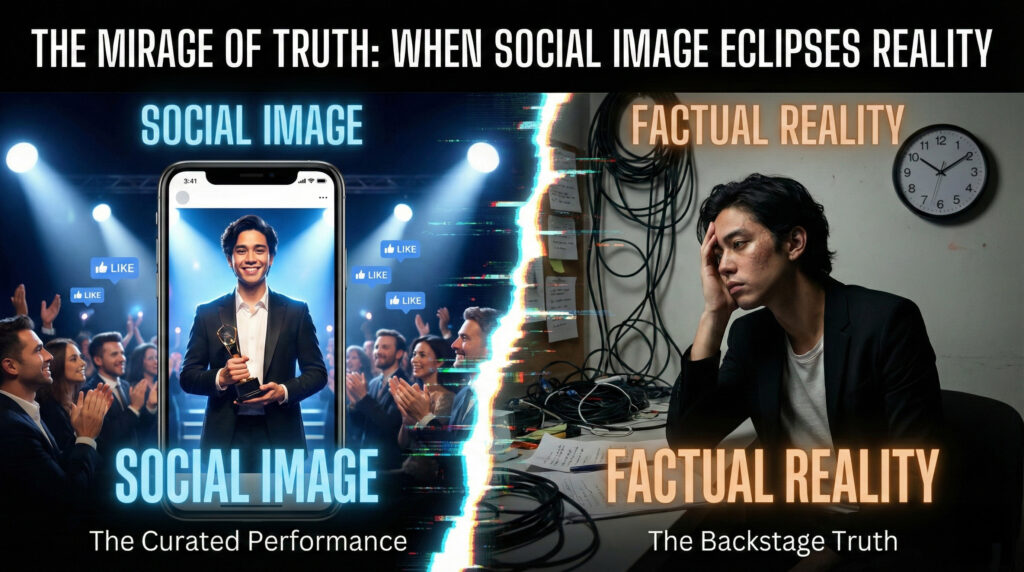
In the digital age, we increasingly inhabit a world where “what looks true” matters more than “what is true.” The tension between Social Image (the perceived narrative) and Factual Reality (the objective happening) has become one of the defining struggles of modern society.
We often assume that with more information at our fingertips, truth would rise to the top. Instead, we are witnessing the opposite: the rise of a “Hyperreality” where the map has replaced the territory, and the image of an event is more powerful, durable, and consequential than the event itself.
The Architecture of Perception
Why does the social image frequently override factual reality? The answer lies in the intersection of human psychology and modern technology.
1. The “Front Stage” Performance
Sociologist Erving Goffman described life as a theater.1 He argued that we are constantly acting on a “Front Stage”—curating our behavior to influence how others see us—while hiding the messy, chaotic reality of our “Back Stage” lives.
- The Reality: A person might be struggling with severe debt, depression, or family crisis.
- The Social Image: Their Instagram feed shows a curated highlight reel of vacations, success, and smiling faces.2
- The Result: The public “buys” the performance. When the factual reality eventually breaks through (e.g., a sudden bankruptcy or scandal), the public is shocked because they mistook the performance for the person.
2. Jean Baudrillard and “Hyperreality”
French philosopher Jean Baudrillard took this further with the concept of Hyperreality.3 He argued that in a media-saturated world, the representation of something eventually becomes “more real” than the thing itself.4
- Example: Consider a viral video of a confrontation. The heavily edited, 30-second clip (the social image) triggers millions of emotional reactions, laws are changed, and reputations are ruined.
- The Fact: The full 2-hour unedited footage might show a completely different context, but it is too boring or complex to go viral. The “image” has already done the work; the “fact” is irrelevant.
Case Studies: Image vs. Fact
History and current events are littered with moments where the narrative swallowed the truth.
| Aspect | The Social Image (Perception) | The Factual Reality (Happening) |
| Crisis Management | “We are handling the situation with transparency.” (PR Statements) | Internal chaos, cover-ups, and lack of actual solutions. |
| Viral Outrage | “This person is a villain who hates animals/children!” (Based on one out-of-context photo) | The person was actually intervening to help, but the camera angle suggested otherwise. |
| Historical Leaders | Mussolini on horseback, looking like a solitary conqueror. | The original photo showed a groom holding the horse’s bridle to keep it steady (later airbrushed out). |
The “Court of Public Opinion”
The most dangerous manifestation of this phenomenon is the “Online Tribunal.” In legal systems, facts are (ideally) paramount. In the court of public opinion, narrative is king.
- The Mechanism: An accusation is launched. If it aligns with the public’s current anxieties or biases (Confirmation Bias), it is shared instantly.
- The Consequence: By the time the factual correction arrives—often weeks later—the damage is permanent. The “Social Image” of the accused as a villain has solidified, rendering their actual innocence a mere footnote.
Why We Prefer the Image
Cognitively, humans are lazy. We prefer heuristics—mental shortcuts—over deep analysis.
- Emotional Resonance: A fake story that makes us feel righteous anger is more “sticky” than a complex truth that is boring or nuanced.
- Social Signaling: Sharing the “correct” social image signals to our tribe that we share their values. Fact-checking is a solitary act; sharing is a social one.
- The Algorithm: Social media platforms are designed to amplify engagement, not accuracy.5 Algorithms push content that generates reaction (the Image) rather than content that generates understanding (the Reality).
Note on “Audience Capture”: Influencers and public figures often fall into a trap where they must essentially become a caricature of themselves to please their audience. They begin to believe their own hype, causing their private reality to collapse under the weight of their public image.
Conclusion: Returning to the Real
The dominance of social image over factual reality creates a brittle society. It fosters polarization, as different groups live in different “image worlds” that share no common facts.6 To combat this, we must cultivate Digital Stoicism: the ability to pause, disconnect the emotional reaction from the consumption of information, and demand the “Back Stage” context before accepting the “Front Stage” performance.7
In a world of filters, the most revolutionary act is to seek the raw, unedited grain of truth.